

Solving Shoulder Pain:
From Frozen Shoulder to Rotator Cuff Injuries
Shoulder pain is one of the most common complaints our patients bring to College Park Physical Therapy, and rightfully so. It can limit your daily activities, disrupt sleep, and steal your independence. But the good news is: many shoulder problems respond very well to physical therapy. Here, we break down two of the most frequent shoulder conditions we treat – frozen shoulder and rotator cuff injuries – and explain how targeted rehab can help you get back to doing what you love.
Did You Know You Have a Choice?
When your doctor recommends physical therapy, you get to choose the clinic that’s right for you. At College Park Physical Therapy, we’re proud to offer personalized care and support to help you get moving, stay active, and recover faster. Physical therapy at independent outpatient clinics like ours is often a more cost-effective option compared to hospital-based or physician-owned practices, while still delivering the same high level of care.
Thanks to Direct Access, many patients can come to us without a doctor’s referral. That means you can schedule an evaluation and start treatment right away. If your doctor does determine that physical therapy is needed, you can still let them know you choose College Park Physical Therapy as your provider. Choosing the right clinic matters. At CPPT, our experienced team works closely with each patient to create a treatment plan tailored to your goals, whether you’re recovering from an injury, managing chronic pain, or improving overall mobility. Next time your doctor recommends physical therapy, remember: you have the right to choose where you go.
Patient Success
“I arrived at CPPT in extreme pain and using a walker, couldn’t put my foot down. Three weeks later, I discarded the walker and three months after that I graduated. Aidan was kind but pushed me each session. His encouragement kept me going.” -J.W.
Understanding Frozen Shoulder
Frozen shoulder, technically known as adhesive capsulitis, is a condition in which the soft tissues surrounding the shoulder joint become inflamed and stiff. Over time, these tissues develop tight bands or adhesions, limiting how much the shoulder can move.
Full recovery from frozen shoulder can take several months to a couple of years, but the good news is that physical therapy is one of the most effective ways to restore mobility and ease pain.
What About Rotator Cuff Injuries?
The rotator cuff is a group of muscles and tendons that surround the shoulder joint and help stabilize and move the arm. Injuries here often come from overuse (e.g., repetitive overhead activities) or sudden trauma.
Unlike frozen shoulder, which tends to restrict all movement, rotator cuff injuries often show up as sharp pain with specific movements, especially lifting or reaching. You may still be able to passively move the arm (when someone else moves it), but active lifting may be very difficult. Muscle weakness is a common feature because the injured tendons can’t generate force like they used to.
How Physical Therapy Helps
Regardless of whether it’s a frozen shoulder or a rotator cuff issue, physical therapy plays a central role in recovery, but the approach differs depending on the diagnosis.
- For frozen shoulder, therapy focuses first on gentle stretching to open up the joint capsule, then gradually transitions to strengthening. Manual therapy (hands-on techniques) from a skilled therapist can help break up scar tissue and restore mobility.
- For rotator cuff injuries, the goal is to restore muscle balance and neuromuscular control. Therapists often prescribe targeted strengthening exercises for the rotator cuff and surrounding stabilizers, as well as postural training.
In some cases, physical therapists may also use modalities (like heat before stretching or manual mobilizations) to reduce pain and improve tissue mobility.
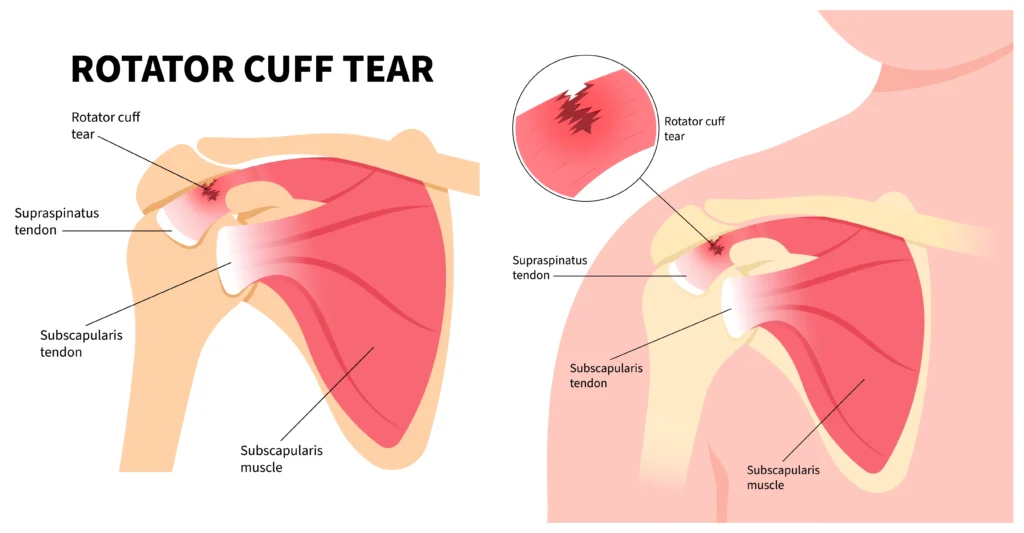
Understanding Rotator Cuff Injuries: Signs and Symptoms
If you’ve been experiencing shoulder pain or discomfort, it’s essential to understand the signs and symptoms of a potential rotator cuff injury. By recognizing these indicators, you can take the crucial first step towards seeking appropriate care and embark on your path to recovery.
Rotator cuff injuries can vary in severity. In addition to pain, they often share these five signs and symptoms:
- Disturbed Sleep: Rotator cuff pain often worsens at night, interfering with sleep. Sleeping on the affected side can be particularly uncomfortable.
- Weakness: Individuals with a rotator cuff injury may experience weakness in the affected shoulder, making it challenging to perform tasks that require lifting, reaching, or holding objects.
- Limited Range of Motion: Reduced mobility in the shoulder is a common symptom. You may struggle to raise your arm, reach behind your back, or perform overhead activities.
- Difficulty with Daily Activities: Rotator cuff injuries can impact daily tasks such as combing hair, dressing, and reaching for items on high shelves. It can also affect sports and recreational activities.
- Gradual Onset: Some rotator cuff injuries develop gradually over time due to overuse, while others may result from a sudden injury or trauma, such as a fall or lifting heavy objects.
Take the First Step Toward Recovery
It’s essential to seek help from one of our College Park Physical Therapy specialists if you experience any of these symptoms, as early intervention can lead to more effective treatment and improved outcomes. Our physical therapists can assess your shoulder and tailor a treatment plan to address your specific needs and goals.
Don’t wait to get help; call today and schedule a consultation!

Recovery Is a Journey, But One You Don’t Have to Walk Alone
One of the biggest challenges with shoulder recovery is patience. With consistent therapy, gentle progression, and professional guidance, most people regain significant motion and function.
At College Park Physical Therapy, our therapists are skilled in evaluating the type of shoulder problem you have and tailoring a plan specifically for you, because no two shoulders are exactly the same. Whether you’re just starting to feel the first twinges of pain or struggling with limited motion for months, we’re here to help you unlock better mobility, reduce discomfort, and rebuild strength safely.
Recipe of the Month: Blender Banana Spinach Muffins

Ingredients:
- 2 eggs
- 2 medium to large extra ripe bananas (with LOTS of brown spots)
- ¼ cup pure maple syrup or honey
- ⅓ cup dairy free milk of choice (I used almond milk)
- 3 cups fresh spinach
- 1 teaspoon vanilla extract
- 1 cup packed blanched almond flour
- 1 cup oat flour, gluten free if desired
- ¼ cup flaxseed meal
- 1 teaspoon cinnamon
- 1 teaspoon baking powder
- ½ teaspoon baking soda
- ¼ teaspoon salt
- Optional: 2 tablespoons hemp seeds
Instructions:
- Preheat the oven to 375 degrees F. Line a muffin tin with 10 muffin liners (we’re only making 10 muffins). Spray the inside of the muffin liners with nonstick cooking spray so the muffins do not stick to the liners.
- Add the eggs, bananas, maple syrup/honey, dairy free milk, spinach and vanilla extract to a large, high powered blender and blend on high for 1 minute or until completely smooth. Set aside.
- In a large bowl whisk together the almond flour, oat flour, flaxseed meal, cinnamon, baking powder, baking soda and salt until well combined. Pour the blended wet ingredients over the dry ingredients and mix with a wooden spoon until well combined. Feel free to stir in hemp hearts, if using. Divide the batter between the muffin liners.
- Bake for 20-25 minutes or until a toothpick comes out clean or with just a few crumbs attached.
Join Our Team
We may be the place for you if you want to be a part of a skilled, dedicated, and attentive physical therapy team that is helping people fully recover and changing the lives of people in your community!
Please apply on our website today if you believe you would be a good fit for our team of dedicated and compassionate therapists, coordinators, representatives, technicians, and assistants.